Wearing Multiple Hats for Success as an ID
Instructional designers wear many hats—learning designer, interpreter, project manager, quality assurance partner, accessibility advocate, and more.
Effective learning doesn’t just depend on creativity or good tools.
It depends on a set of essential, invisible skills that rarely make it into job descriptions.
When this work is done well, learning feels easy.
Outcomes are met.
The experience feels seamless.
No learner(s) see the complexity behind the learning experience.
Let’s talk about these many hats—and the hidden work that actually makes learning effective.
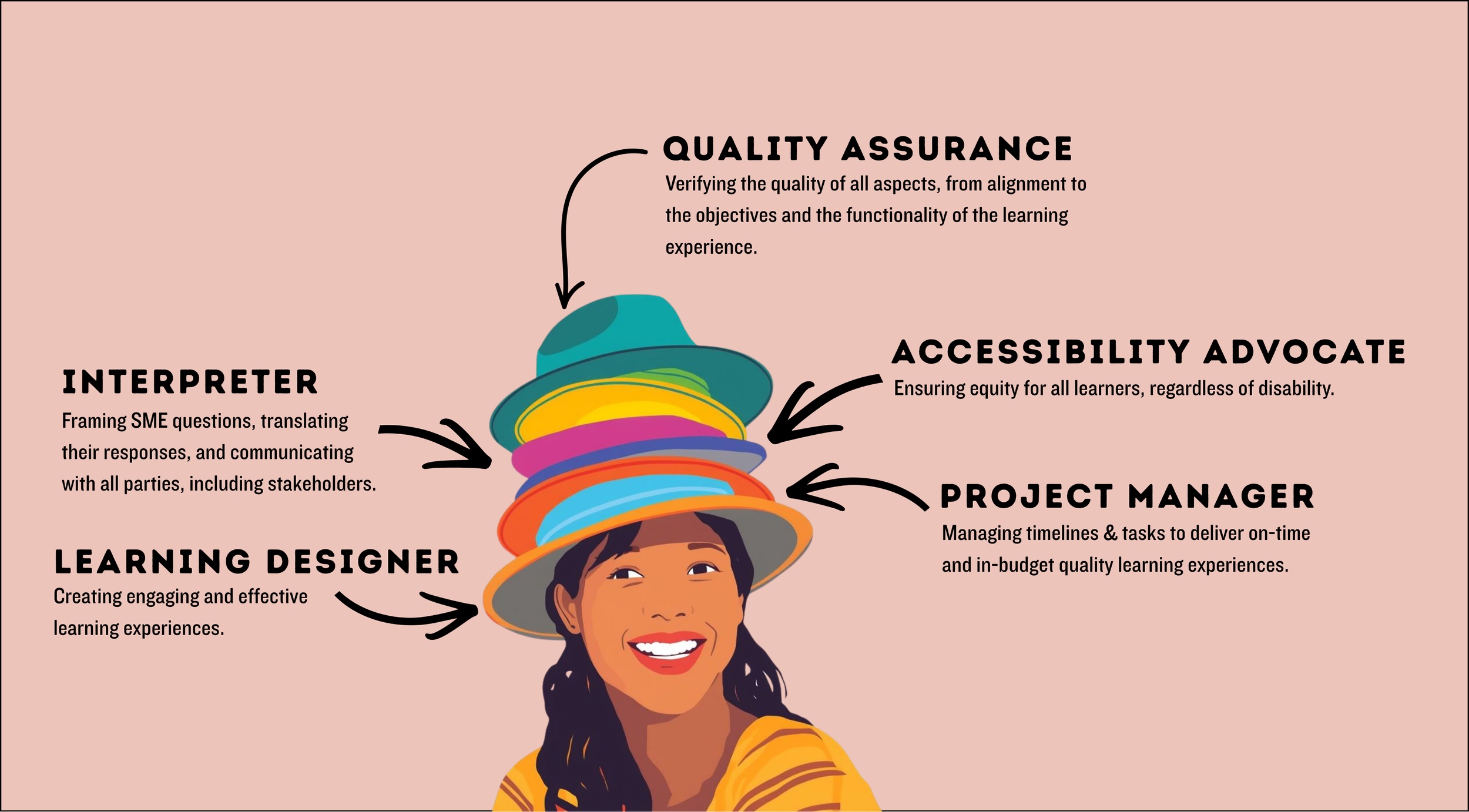
Source: Lawson, L. (2026). The Hats of an Instructional Designer [Digital graphic]. Canva. https://www.canva.com/design/DAHAY0Yiv94/dZXgZVQcFtEO3Ca51IkUDQ/view?utm_content=DAHAY0Yiv94&utm_campaign=designshare&utm_medium=link2&utm_source=uniquelinks&utlId=hb467a6cb55
Hat #1: The Learning Designer
Turning Complexity Into Clarity
At the core, IDs create engaging and effective learning experiences.
But what makes learning “effective”? A review in the Educational Psychologist reinforced that instructional alignment, such as validating that learning objectives, activities, and assessments align—significantly improves learner outcomes (Schneider & Preckel, 2022).
Similarly, cognitive load research verified that poorly structured content overwhelms learners. Sweller et al. (2021) note that instructional designers must consider the roles of intrinsic and extraneous cognitive load in order to foster schema acquisition.
Translation: if content feels confusing, it’s not the learner’s fault—it’s a design issue.
ID’s simplify, reduce cognitive strain, and design with intention.
And when done well, the learning feels effortless.
Hat #2: The Interpreter
Translating SME Expertise Into Real Learning
SMEs verbalize complex topics. IDs translate those complex topics for clear learning.
One of the most critical—but invisible—skills of an instructional designer is translation:
Detailing and framing SME questions for specific, clear answers
Extracting what learners need to know
Discarding what would be nice for learners to know
Converting expertise into accessible, everyday language
Communicating clearly across all levels of stakeholders
In 2023, the Association for Talent Development (ATD) reported that communication and stakeholder management are among the top competencies for high-performing learning professionals.
Yet this work rarely shows up on a final slide deck.
It shows up in the absence of confusion.
Hat #3: The Project Manager
Managing Scope, Trade-offs, and Timelines
Learning occurs within budgets, deadlines, and constantly competing priorities.
Strong instructional designers:
Initiate tasks early to protect timelines
Make scope decisions before the design process begins
Navigate trade-offs between “ideal” and “realistic”
Protect the integrity of LO’s
A PMI report (2021) found that 11.4% of investment in learning design is wasted due to poor project performance—and ineffective communication is a primary contributor.
When IDs proactively communicate, manage scope, and execute timelines, they are not “just coordinating.” They are safeguarding learning integrity.
Good project management doesn’t restrict creativity. It makes the highest level of learning possible.
Hat #4: The Quality Assurance Partner
Testing Before It Breaks
No one notices QA when it’s done well.
However, it is always noticed it when it’s not done accurately.
Functionality testing, assessment validation, alignment checks, accessibility audits—these are quiet forms of excellence.
An EDUCAUSE report (2022) on digital learning environments emphasized that learner trust is strongly influenced by platform reliability and usability. If something breaks, cognitive focus shifts from learning to frustration. All learning goes out the window.
Quality assurance isn’t administrative busywork. It’s an essential and underrated part of the learning experience.
Hat #5: The Accessibility Advocate
Designing for All Learners
Accessibility is a foundational aspect from day one: It is not an add-on.
The World Health Organization estimates that over 1.3 billion people globally experience significant disability (WHO, 2023).
Designing without accessibility in mind creates an inequitable learning environment for billions of learners.
The 2022 WebAIM Million report found that over 96% of homepages analyzed had detectable accessibility failures. That statistic alone should give every instructional designer pause.
The minimum requirements:
All usability is functional with a keyboard-only or, a mouse, or trackball mouse only
Alt text is accurately descriptive and meaningful
Captions are accurate and display on time and with high contrast
Color contrast is passable as per the WebAim Standards
Assessments create equitability via personalized feedback
Navigation allows for flexibility and encourages intuitive UI flow
This isn’t extra credit. It’s ethical design.
Hat #6: The Preventative Strategist
Making Early Decisions That Prevent Future Confusion
Here’s the truth most people don’t see:
The most important ID decisions happen before development begins.
Clarifying LO’s
Defining what “success” looks like
Determining assessment strategy
Choosing modality intentionally
Aligning stakeholders early
The earlier clarity is established, the less confusion emerges downstream.
As a 2021 Harvard Business Review article on cross-functional collaboration noted, ambiguity early in projects compounds into inefficiency and rework later.
IDs who ask the hard questions at the beginning save the entire team precious, workable time—and protect the learner experience.
When the learning design process is done well, the multiple hats that IDs wear simply disappear.
When instructional design is strong:
Learning feels intuitive.
Assessments feel fair.
Content feels clear.
Timelines feel manageable.
Outcomes are met.
And most people assume it was “simple.”
It wasn’t.
It was thoughtful, strategic, collaborative, and preventative.
The complexity stayed behind the scenes.
So… Which Hat Do You Wear Most?
Every instructional designer leans into different strengths.
Some thrive in SME translation.
Some love the precision of alignment and QA.
Some are energized by project orchestration.
Some are passionate about accessibility advocacy.
The key is recognizing that all of these hats matter—and that the invisible work is often the most valuable.
Because the best instructional designers don’t just design courses.
They design clarity for learners and audiences of all types.
References
Association for Talent Development. (2023). Talent development capability model. ATD Press.
EDUCAUSE. (2022). 2022 EDUCAUSE horizon report: Teaching and learning edition. EDUCAUSE. https://www.educause.edu/horizon-report-teaching-and-learning-2022
Harvard Business Review. (2021). How to improve cross-functional collaboration. Harvard Business Review Press.
Lawson, L. (2026). The Hats of an Instructional Designer [Digital graphic]. Canva. https://www.canva.com/design/DAHAY0Yiv94/dZXgZVQcFtEO3Ca51IkUDQ/view?utm_content=DAHAY0Yiv94&utm_campaign=designshare&utm_medium=link2&utm_source=uniquelinks&utlId=hb467a6cb55
Project Management Institute. (2021). Pulse of the profession 2021: Beyond agility. Project Management Institute. https://www.pmi.org/learning/thought-leadership/pulse
Schneider, M., & Preckel, F. (2022). Variables associated with achievement in higher education: A systematic review of meta-analyses. Educational Psychologist, 57(2), 101–124. https://doi.org/10.1080/00461520.2021.1899037
Sweller, J., Ayres, P., & Kalyuga, S. (2021). Cognitive load theory (2nd ed.). Springer. https://doi.org/10.1007/978-1-0716-0762-3
WebAIM. (2022). The WebAIM million: The 2022 report on the accessibility of the top 1,000,000 home pages. WebAIM. https://webaim.org/projects/million/2022
World Health Organization. (2023). Global report on health equity for persons with disabilities. World Health Organization. https://www.who.int/publications/i/item/9789240063600
Thank you for joining me today! Let’s keep learning altogether, as lifelong #LearningMatters.
Best,
Laura Lawson
LearningMatters, LLC
Instructional Designer